Welcome to the ERTH 170, Atmospheric Science, public webpage for the Spring 2026 semester.
I will try to update this page every few days during the semester.
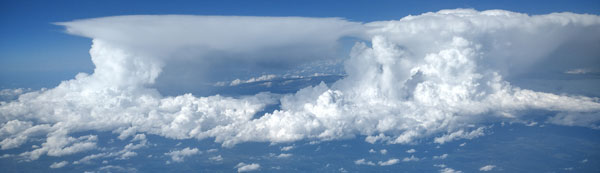
Thunderstorms over the midwest on 8 July 2025. Photo by Shane Mayor.
Spring 2026 Lectures: MWF, 1:00 - 1:50 PM.
Required book: Meteorology Today 13th edition by C. Donald Ahrens and Robert Henson.
Weds., 21 Jan., Course overview, expectations, and introduction to how solar energy drives weather and climate.
Fri., 23 Jan., Defined weather vs. climate and began Earth–Sun relationships and atmospheric structure.
Mon., 26 Jan., Global energy budget, atmospheric composition, greenhouse effect, lapse rate, and weather observations.
Weds., 28 Jan., CO₂ trends, combustion chemistry, sources and sinks, and stratospheric ozone science.
Fri., 30 Jan., Quiz #1. CO₂ trends and combustion chemistry, oxygen decline, and stratospheric ozone and the ozone hole.
Mon., 2 Feb., Finished atmospheric composition and particles, then began Chapter 2 on energy, units (SI), and forms of energy.
Weds., 4 Feb., Gravitational and kinetic energy, temperature scales, specific heat capacity, and mechanisms of energy transfer (conduction and convection).
Fri., 6 Feb., Quiz #2. Convection in the atmosphere (including cumulus clouds and boundary layers), sensible vs. latent heat, and phase changes.
Mon., 9 Feb., Phase changes of water, latent heat values, condensation and evaporation effects, and the air parcel concept (expansion cooling and compression warming).
Weds., 11 Feb., Convection vs. advection, wave–particle duality of radiation, blackbody radiation, and the Stefan–Boltzmann law.
Fri., 13 Feb., Quiz #3. Wien’s law, selective absorbers/emitters, Kirchhoff’s law, greenhouse gases (N₂O, CH₄, O₃, H₂O, CO₂), and the atmospheric window.
Mon., 16 Feb., Atmospheric windows, the greenhouse effect, albedo, Earth–atmosphere energy balance, and recent global temperature trends.
Weds., 18 Feb., Completed Chapter 2 review and began Chapter 3 on seasonal temperature variations, Earth–Sun geometry, and solstices/equinoxes.
Fri., 20 Feb., Quiz #4. Diurnal temperature cycle over land, surface energy balance, cold-air drainage at night, and application of the ideal gas law to density differences.
Mon., 23 Feb., Completed Chapter 3 with cold-air basins, thermal belts, frost protection methods, cloud effects on daily range, and began Chapter 4 on humidity.
Weds., 25 Feb., Began Chapter 4 with roles of water vapor, definitions of absolute/specific humidity and mixing ratio, relative humidity, and saturation concepts.
Fri., 27 Feb., Quiz #5. Conclusion of Chapter 4.
Mon., 2 Mar., Review for first mid-term exam.
Weds., 4 Mar., Mid-term Exam #1: Chapters 1 - 4.
Fri., 6 Mar., Long discussion about current weather, El Nino, then Begin Chapter 5: Condensation: Dew, Fog, and Clouds. Today: Dew and frost.
Mon., 9 Mar., Condensation and deposition on nuclei; heterogeneous and homogeneous nucleation; hygroscopic and hydrophobic nuclei; haze; scattering; visibility
Weds., 11 Mar., Discussion of the impact of boreal forests radiative forcing through production of CCN. Direct and indirect effects; begin types of fog
Fri., 13 Mar., Quiz #6 on Chapter 5. Complete types of fog (radiation, advection, mixing, upslope) and begin types of clouds.
Mon., 16 Mar., Spring break. No classes.
Weds., 18 Mar., Spring break. No classes.
Fri., 20 Mar., Spring break. No classes.
Mon., 23 Mar., Discussion of supercooled droplets, mixed phase clouds; and laminar and turbulent flow; specialty clouds.
Weds., 25 Mar., Complete Chapter 5 and Begin Chapter 6: discussion of mechanical and fluid stability (density, buoyancy, parcel, lapse rates, etc.)
Fri., 27 Mar., Quiz #7. Distribute Special Assignment #2. How to assess static stability: environmental and process lapse rates
Mon., 30 Mar., Class cloud photos, then continue with procedure to determine static stability, with discussion of absolutely stable environments.
Weds., 1 Apr., Continued Chapter 6 on atmospheric stability, inversions, and destabilization mechanisms.
Fri., 3 Apr., Quiz #8. Special Assignment #2 due. Continued Chapter 6 by covering convection, cumulus development, and entrainment.
Mon., 6 Apr., Wind shear, organization of cumulus clouds (streets), wave clouds, billow clouds, completed Chapter 6.
Weds., 8 Apr., Began Chapter 7: Precipitation. Droplets, curvature and solute effects, molecular diffusion, warm clouds, collision and coalescence.
Fri., 10 Apr., Quiz #9. Continue Chapter 7: ice-crystal (Bergeron) process. Review of ways humans can impact clouds.
Mon., 13 Apr., Completed Chapter 7 and began Chapter 8: Air Pressure and Wind: Started discussion of pressure and barometers.
Weds., 15 Apr., Types of barometers, what is air pressure, direct thermal circulation, correcting station pressure for elevation to get sea level pressure.
Fri., 17 Apr., Quiz #10. Newton's laws of motion, pressure gradient force, hydrostatic balance, Coriolis force, and geostrophic balance andflow.
Mon., 20 Apr., Complete Chapter 8: Geostrophic flow in the free-troposphere, and balanced flow in the planetary boundary layer.
Weds., 22 Apr., Mid-term exam #2 on Chapters 5 - 8.
Fri., 24 Apr., Begin Chapter 9: Wind: Small-scale and Local Systems. Scales of atmospheric motion, turbulence, eddies, no-slip, begin viscosity.
Mon., 27 Apr., Momentum transport by molecular and eddy viscosity. Breaking waves in stratified atmospheres.
Weds., 29 Apr., The power of the wind and wind near the surface of the Earth. Local/mesoscale circulations including land and sea breezes.
Fri., 1 May, Quiz #11 and SOFTs. Then anabatic and katabatic flows, especially over Antarctica.
Mon., 4 May, Katabatic flows and relations to wildfires; then discussion of the Dust Bowl and haboobs.
Weds., 6 May, Chapter 10: Global Wind Systems: 3-cell general circulation model and features of it that are observed in the real world.
Fri., 8 May, Quiz #12. Atmosphere-Ocean interactions including the Ekman spiral and transport in the upper ocean, major gyres, and El Nino/Southern Oscillation (ENSO).
Weds., 11 May, Comprehensive Final Exam
Dr. Mayor's page