Welcome to the ERTH 353, Environmental Fluid Mechanics, public webpage for the Spring 2026 semester.
I will try to update this page every few days during the semester.
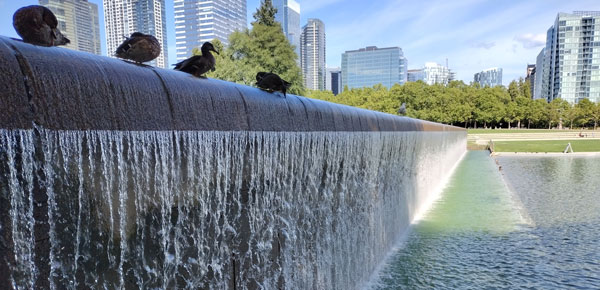
Waterfall at the Bellevue Downtown Park, Bellevue, Washington, on 26 July 2025. Photo by Shane Mayor.
Instructor: Dr. Shane Mayor
Spring 2026 Lectures: MWF, 1:00 - 1:50 PM.
Required book: None
In this course, we derive and develop the Navier-Stokes equations.
Weds., 21 Jan., First day of the semester. Functions, independent and dependent variables.
Fri., 23 Jan., Ordinary (1 independent variable) versus partial derivatives (>1 independent variables)
Mon., 26 Jan., Partial derivatives, vectors, gradient, unit vectors, nabla
Weds., 28 Jan., Review for Friday's quiz: x, y, z, i, j, k, u, v, w, T, P, etc.
Fri., 30 Jan., Quiz #1. Then more on vectors and components. Then, continuum hypothesis and Knudsen number
Mon., 2 Feb., Flux-gradient relationships: Fourier's law of heat conduction, Fick's law of diffusion, and Newton's Law of viscosity
Weds., 4 Feb., Review for quiz. Then Couette flow, stress, surface forces on a fluid cube.
Fri., 6 Feb., Quiz #2. Newton’s 2nd law for a fluid parcel: body vs surface forces
Mon., 9 Feb., Derivation of the Cauchy momentum equation.
Weds., 11 Feb., Cauchy momentum equation in index notation; stress-tensor symmetry
Fri., 13 Feb., Quiz #3. continue discussion of index notation, Kronecker delta
Mon., 16 Feb., Strain rate tensor, divergence, and constitutive equation for incompressible Newtonian fluid
Weds., 18 Feb., Derivation of pressure gradient force and Diffusion of momentum due to viscosity.
Fri., 20 Feb., Quiz #4. Acceleration due to molecular viscosity and concave and convex velocity profiles. Begin discussion of body forces: Gravity.
Mon., 23 Feb., True gravity, centripetal and centrifugal acceleration, and apparent gravity
Weds., 25 Feb., First Annual Environmental Fluid Mechanics Breakfast at Mom's restaurant
Fri., 27 Feb., Discussion of units, review of apparent gravity, true gravity, and centrifugal forces
Mon., 2 Mar., Vector cross-product as a mathematical tool for developing Coriolis term. Velocity of a point on a rotating plane.
Weds., 4 Mar., Derivation of expression for acceleration of a non-inertial coordinate system.
Fri., 6 Mar., Quiz #5. Inclusion of effects of non-inertial coordinate system in Navier-Stokes: Coriolis term for flat polar tangent plane.
Mon., 9 Mar., Derivation of latitude-dependent Coriolis terms
Weds., 11 Mar., Integrating the Coriolis terms (twice) to calculate deflection of a moving parcel or projectile in a non-inertial reference frame.
Fri., 13 Mar., Quiz #6. Derivation of advective terms and Eulerian reference frame.
Mon., 16 Mar., Spring break. No classes.
Weds., 18 Mar., Spring break. No classes.
Fri., 20 Mar., Spring break. No classes.
Mon., 23 Mar., The Coriolis parameter and the permutation or Levi-Civita symbol.
Weds., 25 Mar., Use of the Levi-Civita symbol for creation of the Coriolis term in the NSE. Begin discussion of the characteristics of turbulence (7 of 9).
Fri., 27 Mar., Quiz #7. Complete discussion of characteristics of turbulence (8 and 9 of 9). Then introduce Reynolds decomposition.
Mon., 30 Mar., Reynolds decomposition and how to compute mean, variance, standard deviation, TKE, MKE, and covariance of turbulent time series data.
Weds., 1 Apr., Introduced the Boussinesq approximation, Reynolds decomposition, and averaging rules.
Fri., 3 Apr., Quiz #8. Applied Reynolds averaging term by term to derive the Reynolds-averaged Navier-Stokes equations.
Mon., 6 Apr., Began interpretation of Reynolds stress and rewrote the turbulent advection term in conservative form.
Weds., 8 Apr., Showed how the Reynolds stress term emerges as the divergence of a covariance, revealing turbulent transport of mean momentum.
Fri., 10 Apr., Compared instantaneous NSE with RANS; began discussion of turbulence closure; reviewed Reynolds stress tensor.
Mon., 13 Apr., Reviewed previous lecture, continued discussion of closure: Boussinesq eddy-viscosity hypothesis.
Weds., 15 Apr., Quiz #9. Begin scale analysis of the horizontal equations of motion.
Fri., 17 Apr., Complete scale analysis of the horizontal equations of motion for synoptic scale systems and derive geostrophic wind.
Mon., 20 Apr., Scale analysis of the vertical equation of motion for synoptic scale systems: hydrostatic balance and barometric equation.
Weds., 22 Apr.,Geostrophic flow in free atmosphere, hemispheric polar vortex. Then Ekman layer, Ekman balance equations, Ekman spiral (in atmosphere).
Fri., 24 Apr., Quiz #10. Discussion of Ekman spiral assumptions, Ekman transport and pumping, and coupling of atmosphere and ocean Ekman spirals.
Mon., 27 Apr., Editing our Fluid Mechanics notes on Overleaf
Weds., 29 Apr., Editing our Fluid Mechanics notes on Overleaf
Fri., 1 May, Editing our Fluid Mechanics notes on Overleaf
Mon., 4 May, Editing our Fluid Mechanics notes on Overleaf
Weds., 6 May, Editing our Fluid Mechanics notes on Overleaf
Fri., 8 May, Editing our Fluid Mechanics notes on Overleaf
Dr. Mayor's page