Welcome to the ERTH 440, Environmental Sensing, webpage for the Fall 2026 semester.
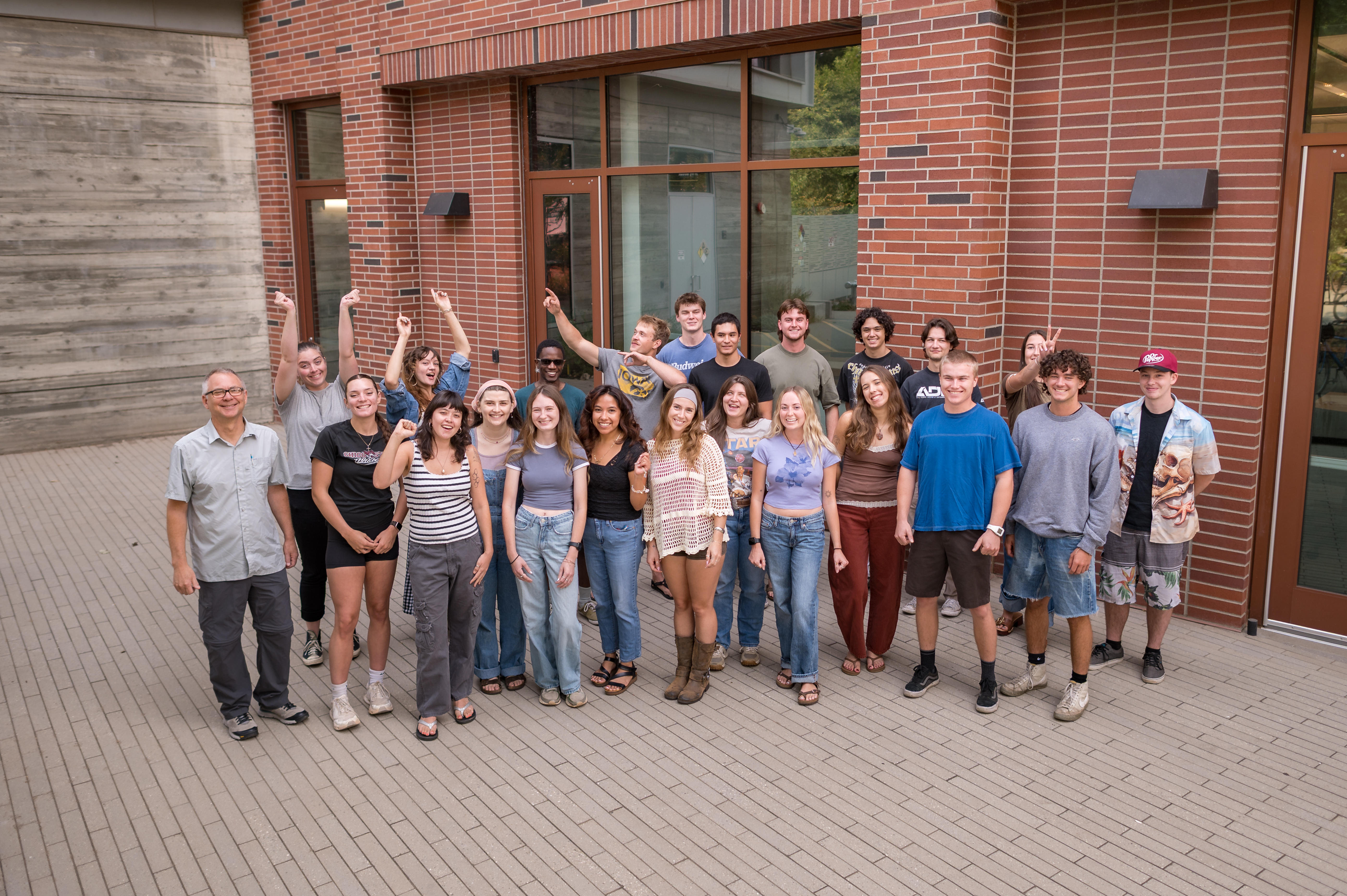
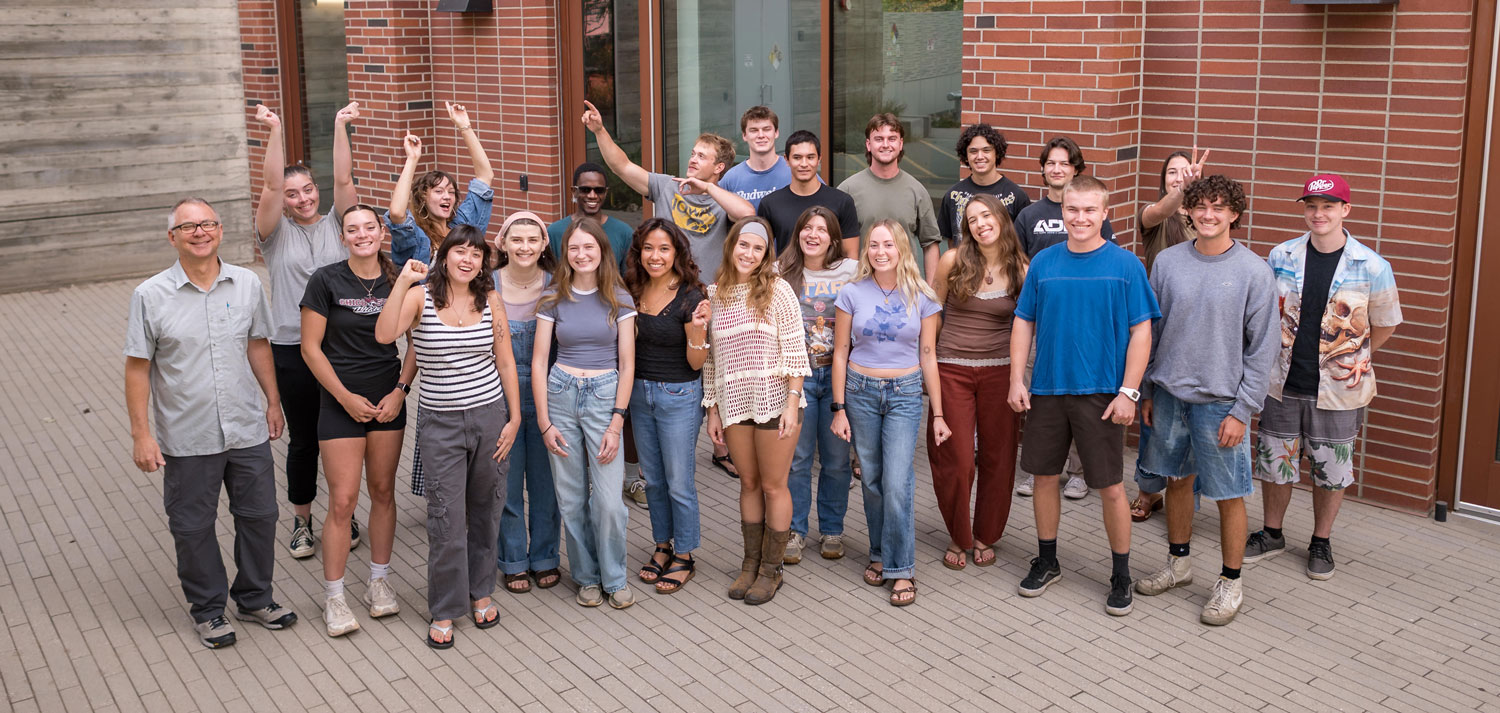 Fall 2026 ERTH 440 class on August 31. Photo by Jason Halley.
This page will be updated every few days as the course progresses...
Required book: Meteorological Measurement and Instrumentation by Giles R. Harrison, (c)2015.
Link to on-line library version (requires csuchico.edu connection).
Link to Publisher.
Aug. 24, Mon., Lecture: Course overview; Arduino-based environmental sensing, sensors and data acquisition, MATLAB, and term-project expectations
Aug. 26, Weds., Lecture: Instrument terminology and measurement systems; in situ vs. remote sensing, platforms and telemetry, analog vs. digital signals, binary numbers, and analog-to-digital conversion.
Aug. 27, Thurs., Lab #1: Using Arduinos to blink LEDs and sensing temperature from a TMP36.
Aug. 31, Mon., Lecture: Analog-to-digital conversion: sampling, quantization, resolution, sensitivity, linearity, and dynamic range.
Sept. 2, Weds., Lecture: Instrument performance: dynamic range, time response, hysteresis, calibration, accuracy, and precision.
Sept. 3, Thurs., Lab #2: Using a voltage divider and a thermistor to measure temperature.
Sept. 7, Mon.: Labor Day. Campus closed.
Sept. 9, Weds., Quiz #1. Then Lecture: Derived Newton’s law of cooling and its exponential temperature-response solution, including the time constant.
Sept. 10, Thurs., Lab #3: Soldering headers and pins on to Adafruit data logging shield
Sept. 14, Mon., Lecture: Instrument response time and sampling; what temperature is and how it relates to molecular motion and internal energy.
Sept. 16, Weds., Lecture: Development of thermometry; thermoscopes and liquid-in-glass thermometers, calibration, errors, and shelters.
Sept. 17, Thurs., Lab #4: Logging temperature with the thermistor and data logging shield
Sept. 21, Mon., Lecture: Outdoor air-temperature siting and diurnal variation; maximum/minimum thermometers and introduction to electronic temperature sensors: diodes and thermistors.
Sept. 23, Weds., Lecture: Thermocouples and RTDs; comparison of common electronic temperature sensors; radiation shielding/aspiration for accurate air-temperature measurements.
Sept. 24, Thurs., Lab #5: Characterizing the performance of a thermistor and 14-bit ADC system. Accuracy, precision, resolution, response time in ice and steam.
Sept. 28, Mon., Quiz #2 on temperature and thermometers. Lecture: time-series data and MATLAB datetime; introduction to radiation, radiometry, and radiant energy.
Sept. 30, Weds., Lecture: Electromagnetic radiation as waves and photons; photon energy, the electromagnetic spectrum, and blackbody/Planck radiation.
Oct. 1, Thurs., Lab #5 continued: complete characterization of the thermistor based temperature logging system started in last lab.
Oct. 5, Mon., Lecture: Planck, Stefan–Boltzmann, and Wien laws; radiative properties of materials, propagation of radiation, and examples of radiometers and electronic light sensors.
Oct. 7, Weds., Lecture: Electronic radiation detectors and radiometers, including avalanche photodiodes, photomultiplier tubes, thermopiles, pyranometers, albedometers, PAR sensors, and wavelength-selective filters.
Oct. 8, Thurs., Lab #6: Digital communications via I2C sensors. Logging T and RH data with a SHTC3 sensor and making dual axis graphs in MATLAB.
Oct. 12, Mon., Lecture: Atmospheric scattering and direct versus diffuse solar radiation; pyrheliometers; infrared detection, bolometers and imaging sensors; pyrgeometers and measurement of the surface radiation budget.
Oct. 14, Weds., Quiz #3 on Radiation and radiometers. Lecture: Begin Chapter 6 on water vapor and humidity.
Oct. 15, Thurs., Lab #8: First lab on student led term projects
Oct. 19, Mon., Lecture: Continued water vapor and humidity, including saturation, saturation vapor pressure, relative humidity, dew point, and wet-bulb depression.
Oct. 21, Weds., Lecture: Examined methods for measuring water vapor, including psychrometers, dew-point hygrometers, electronic sensors, optical hygrometers, and cavity ring-down spectroscopy.
Oct. 22, Thurs., Lab #9: Second lab on student led term projects
Oct. 26, Mon., Lecture: Introduced differential absorption lidar (DIAL) and showed how measurements at two wavelengths and two ranges can retrieve the average concentration of an absorbing gas.
Oct. 28, Weds., Quiz #4 on water vapor. Lecture: Concluded water-vapor sensing and began air pressure, including why pressure matters in atmospheric science and how pressure relates to density and temperature.
Oct. 29, Thurs., Lab #10: Third lab on student led term projects
Nov. 2, Mon., Lecture: Continued air pressure and barometers, covering pressure in fluids, manometers, mercury and aneroid barometers, and pressure hypsometers.
Nov. 4, Weds., Lecture: Completed air pressure and barometers, then introduced wind, static and dynamic pressure, wind components and scales, molecular diffusion, and the origins of turbulence.
Nov. 5, Thurs., Quiz #5 on Pressure and barometers. Lab #11: Fourth lab on student led term projects
Nov. 9, Mon., Lecture: Continued Chapter 8 on wind and wind sensors, including near-surface turbulence, static stability, coherent structures, and the log-wind profile..
Nov. 11, Weds.: Campus closed for Veterans Day
Nov. 12, Thurs., Lab #12: Fifth lab on student led term projects
Nov. 16, Mon., Lecture:
Nov. 18, Weds., Lecture: Quiz #6 on wind and wind sensors
Nov. 19, Thurs., Lab #13:
Nov. 23, Mon.: No classes. Fall Break.
Nov. 25, Weds.: No classes. Fall Break.
Nov. 26, Thurs.: No classes. Thanksgiving/Fall Break.
Nov. 30, Mon., Lecture:
Dec. 2, Weds., Lecture:
Dec. 3, Thurs., Lab #14:
Dec. 7, Mon., Lecture:
Dec. 9, Weds., Lecture:
Dec. 10, Thurs., Lab #15:
Dec. 14, Mon., 12:00-1:50 PM: Final comprehensive exam
Dr. Mayor's page